Mu Arae From Wikipedia, the free encyclopedia Jump to navigationJump to search Mu Arae Mu Arae Observation data Epoch J2000.0 Equinox J2000.0 Constellation Ara Right ascension 17h 44m 08.70114s[1] Declination −51° 50′ 02.5853″[1] Apparent magnitude (V) +5.12 Characteristics Spectral type G3IV–V[2] U−B color index +0.24[3] B−V color index +0.70[3] R−I color index 0.2 Astrometry Radial velocity (Rv) −9.0[4] km/s Proper motion (μ) RA: −16.85[1] mas/yr Dec.: −190.60[1] mas/yr Parallax (π) 64.47 ± 0.31[1] mas Distance 50.6 ± 0.2 ly (15.51 ± 0.07 pc) Absolute magnitude (MV) +4.17[5] Details Mass 1.10 ± 0.01[6] M☉ Radius 1.36 ± 0.01[6] R☉ Luminosity 1.90 ± 0.10[6] L☉ Surface gravity (log g) 4.19[2] cgs Temperature 5820 ± 40[6] K Metallicity 200 ± 5%[6][note 1] Metallicity [Fe/H] 0.30 ± 0.01[6] dex Rotation 31 days Rotational velocity (v sin i) 1.4[7] km/s Age 6.34 ± 0.40[6] Gyr Other designations Cervantes, CD −51° 11094, FK5 662, GC 24024, GJ 691, HD 160691, HIP 86796, HR 6585, SAO 244981 Database references SIMBAD data Exoplanet Archive data ARICNS data Extrasolar Planets Encyclopaedia data Mu Arae (μ Arae, abbreviated Mu Ara, μ Ara), often designated HD 160691, officially named Cervantes /sɜːrˈvæntiːz/ sur-VAN-teez,[8] is a main sequence G-type star approximately 50 light-years away from the Sun in the constellation of Ara. The star has a planetary system with four known extrasolar planets (designated Mu Arae b, c, d and e; later named Quijote, Dulcinea, Rocinante and Sancho, respectively), three of them with masses comparable with that of Jupiter. Mu Arae c, the innermost, was the first hot Neptune or super-Earth discovered. Contents 1 Nomenclature 2 Stellar characteristics 3 Planetary system 3.1 Discovery 3.2 System architecture and habitability 4 See also 5 Notes 6 References 7 External links Nomenclature μ Arae (Latinised to Mu Arae) is the star's Bayer designation. HD 160691 is the entry in the Henry Draper Catalogue. The established convention for extrasolar planets is that the planets receive designations consisting of the star's name followed by lower-case Roman letters starting from "b", in order of discovery.[9] This system was used by a team led by Krzysztof Goździewski.[10] On the other hand, a team led by Francesco Pepe proposed a modification of the designation system, where the planets are designated in order of characterization.[11] Since the parameters of the outermost planet were poorly constrained before the introduction of the 4-planet model of the system, this results in a different order of designations for the planets in the Mu Arae system. Both systems agree on the designation of the 640-day planet as "b". The old system designates the 9-day planet as "d", the 310-day planet as "e" and the outer planet as "c". Since the International Astronomical Union has not defined an official system for designations of extrasolar planets,[12] the issue of which convention is 'correct' remains open, however subsequent scientific publications about this system appear to have adopted the Pepe et al. system, as has the system's entry in the Extrasolar Planets Encyclopaedia.[13][14] In July 2014 the International Astronomical Union launched NameExoWorlds, a process for giving proper names to certain exoplanets and their host stars.[15] The process involved public nomination and voting for the new names.[16] In December 2015, the IAU announced the winning names were Cervantes for this star and Quijote, Dulcinea, Rocinante and Sancho, for its planets (b, c, d, and e, respectively; the IAU used the Pepe et al system).[17][18] The winning names were those submitted by the Planetario de Pamplona, Spain. Miguel de Cervantes Saavedra (1547–1616) was a famous Spanish writer and author of El Ingenioso Hidalgo Don Quixote de la Mancha. The planets are named after characters of that novel: Quijote was the lead character; Dulcinea his love interest; Rocinante his horse, and Sancho his squire.[19] In 2016, the IAU organized a Working Group on Star Names (WGSN)[20] to catalog and standardize proper names for stars. In its first bulletin of July 2016,[21] the WGSN explicitly recognized the names of exoplanets and their host stars approved by the Executive Committee Working Group Public Naming of Planets and Planetary Satellites, including the names of stars adopted during the 2015 NameExoWorlds campaign. This star is now so entered in the IAU Catalog of Star Names.[8] Stellar characteristics According to measurements made by the Hipparcos astrometric satellite, Mu Arae exhibits a parallax of 64.47 milliarcseconds as the Earth moves around the Sun. When combined with the known distance from the Earth to the Sun, this means the star is located at a distance of 50.6 light-years (15.51 parsecs).[1][note 2] Seen from Earth it has an apparent magnitude of +5.12 and is visible to the naked eye. Asteroseismic analysis of the star reveals it is approximately 10% more massive than the Sun and significantly older, at around 6.34 billion years. The radius of the star is 36% greater than that of the Sun and it is 90% more luminous. The star contains twice the abundance of iron relative to hydrogen of the Sun and is therefore described as metal-rich. Mu Arae is also more enriched than the Sun in the element helium.[6] Mu Arae has a listed spectral type of G3IV–V.[2] The G3 part means the star is similar to the Sun (a G2V star). The star may be entering the subgiant stage of its evolution as it starts to run out of hydrogen in its core. This is reflected in its uncertain luminosity class, between IV (the subgiants) and V (main sequence dwarf star stars like the Sun). Planetary system File:Exoplanets of Cervantes.ogv Emulation in Celestia of the exoplanets of Cervantes based in the Sudarsky's gas giant classification: Dulcinea, Rocinante, Quijote y Sancho. The Mu Arae star with distance relationships for its four planets The orbits of the outer three planets in the Mu Arae system compared with those in the Solar System. Central star is not to scale. At the scale of this picture, the innermost planet would be located at the edge of the disc representing the central star. Discovery In 2001, an extrasolar planet was announced by the Anglo-Australian Planet Search team, together with the planet orbiting Epsilon Reticuli. The planet, designated Mu Arae b, was thought to be in a highly eccentric orbit of around 743 days.[22] The discovery was made by analysing variations in the star's radial velocity (measured by observing the Doppler shift of the star's spectral lines) as a result of being pulled around by the planet's gravity. Further observations revealed the presence of a second object in the system (now designated as Mu Arae e), which was published in 2004. At the time, the parameters of this planet were poorly constrained and it was thought to be in an orbit of around 8.2 years with a high eccentricity.[23] Later in 2004, a small inner planet designated Mu Arae c was announced with a mass comparable with that of Uranus in a 9-day orbit. This was the first of the class of planets known as "hot Neptunes" to be discovered. The discovery was made by making high-precision radial velocity measurements with the High Accuracy Radial Velocity Planet Searcher (HARPS) spectrograph.[24] In 2006, two teams, one led by Krzysztof Goździewski and the other by Francesco Pepe independently announced four-planet models for the radial velocity measurements of the star, with a new planet (Mu Arae d) in a near-circular orbit lasting approximately 311 days.[10][11] The new model gives revised parameters for the previously known planets, with lower eccentricity orbits than in the previous model and including a more robust characterization of the orbit of Mu Arae e. The discovery of the fourth planet made Mu Arae the second known four-planet extrasolar system, after 55 Cancri. System architecture and habitability The Mu Arae system consists of an inner Uranus-mass planet in a tight 9-day orbit and three massive planets, probably gas giants, on wide, near-circular orbits, which contrasts with the high-eccentricity orbits typically observed for long-period extrasolar planets. The Uranus-mass planet may be a chthonian planet, the core of a gas giant which has had its outer layers stripped away by stellar radiation.[25] Alternatively it may have formed in the inner regions of the Mu Arae system as a rocky "super-Earth".[24] The inner gas giants "d" and "b" are located close to the 2:1 orbital resonance which causes them to undergo strong interactions. The best-fit solution to the system is actually unstable:[26] simulations suggest the system is destroyed after 78 million years, which is significantly shorter than the estimated age of the star system. More stable solutions, including ones in which the two planets are actually in the resonance (similar to the situation in the Gliese 876 system) can be found which give only a slightly worse fit to the data.[11] Searches for circumstellar discs show no evidence for a debris disc similar to the Kuiper belt around Mu Arae. If Mu Arae does have a Kuiper belt, it is too faint to be detected with current instruments.[27] The gas giant planet "b" is located in the liquid water habitable zone of Mu Arae. This would prevent an Earth-like planet from forming in the habitable zone, however large moons of the gas giant could potentially support liquid water.[improper synthesis?] On the other hand, it is unclear whether such massive moons could actually form around a gas giant planet, thanks to an apparent scaling law between the mass of the planet and its satellite system.[28] In addition, measurements of the star's ultraviolet flux suggest that any potentially habitable planets or moons may not receive enough ultraviolet to trigger the formation of biomolecules.[29] Planet "d" would receive a similar amount of ultraviolet to the Earth and thus lies in the ultraviolet habitable zone. However, it would be too hot for any moons to support surface liquid water. The Mu Arae planetary system[11] Companion (in order from star) Mass Semimajor axis (AU) Orbital period (days) Eccentricity Inclination Radius c (Dulcinea) >10.5551 M🜨 0.09094 9.6386 ± 0.0015 0.172 ± 0.04 — — d (Rocinante) >0.5219 MJ 0.921 310.55 ± 0.83 0.0666 ± 0.0122 — — b (Quijote) >1.676 MJ 1.497 643.25 ± 0.90 0.128 ± 0.017 — — e (Sancho) >1.814 MJ 5.235 4205.8 ± 758.9 0.0985 ± 0.0627 — — See also 55 Cancri Exoplanet Lists of exoplanets PSR B1257+12 Notes From [Fe/H] = 0.30 ± 0.01 The formula for converting parallax to distance is {\displaystyle \scriptstyle \mathrm {Distance\ in\ parsecs} ={\frac {1}{\mathrm {parallax\ in\ arcseconds} }}}\scriptstyle \mathrm {Distance\ in\ parsecs} ={\frac {1}{\mathrm {parallax\ in\ arcseconds} }} References van Leeuwen, F. (November 2007). "Validation of the new Hipparcos reduction". Astronomy and Astrophysics. 474 (2): 653–664. arXiv:0708.1752. Bibcode:2007A&A...474..653V. doi:10.1051/0004-6361:20078357. S2CID 18759600. Gray, R. O.; et al. (July 2006). "Contributions to the Nearby Stars (NStars) Project: Spectroscopy of Stars Earlier than M0 within 40 parsecs: The Northern Sample I". The Astronomical Journal. 132 (1): 161–170. arXiv:astro-ph/0603770. Bibcode:2006AJ....132..161G. doi:10.1086/504637. S2CID 119476992. Feinstein, A. (1966). "Photoelectric observations of Southern late-type stars". The Information Bulletin for the Southern Hemisphere. 8: 30. Bibcode:1966IBSH....8...30F. Wielen, R.; et al. (1999). "Sixth Catalogue of Fundamental Stars (FK6). Part I. Basic fundamental stars with direct solutions". Veröff. Astron. Rechen-Inst. Heidelb. Astronomisches Rechen-Institut Heidelberg. 35 (35): 1. Bibcode:1999VeARI..35....1W. Anderson, E.; Francis, Ch. (2012). "XHIP: An extended hipparcos compilation". Astronomy Letters. 38 (5): 331. arXiv:1108.4971. Bibcode:2012AstL...38..331A. doi:10.1134/S1063773712050015. S2CID 119257644. Soriano, M.; Vauclair, S. (2009). "New seismic analysis of the exoplanet-host star Mu Arae". Astronomy and Astrophysics. 513: A49. arXiv:0903.5475. Bibcode:2010A&A...513A..49S. doi:10.1051/0004-6361/200911862. S2CID 5688996. Bruntt, H.; et al. (July 2010). "Accurate fundamental parameters for 23 bright solar-type stars". Monthly Notices of the Royal Astronomical Society. 405 (3): 1907–1923. arXiv:1002.4268. Bibcode:2010MNRAS.405.1907B. doi:10.1111/j.1365-2966.2010.16575.x. S2CID 118495267. "IAU Catalog of Star Names". Retrieved 28 July 2016. Hessman, F. V.; Dhillon, V. S.; Winget, D. E.; Schreiber, M. R.; Horne, K.; Marsh, T. R.; Guenther, E.; Schwope, A.; Heber, U. (2010). "On the naming convention used for multiple star systems and extrasolar planets". arXiv:1012.0707 [astro-ph.SR]. Gozdziewski, K.; Maciejewski, Andrzej J.; Migaszewski, Cezary (2007). "On the extrasolar multi-planet system around HD160691". The Astrophysical Journal. 657 (1): 546–558. arXiv:astro-ph/0608279. Bibcode:2007ApJ...657..546G. doi:10.1086/510554. S2CID 16620036. Pepe, F.; Correia, A. C. M.; Mayor, M.; Tamuz, O.; Benz, W.; Bertaux, J. -L.; Bouchy, F.; Couetdic, J.; Laskar, J.; Lovis, C.; Naef, D.; Queloz, D.; Santos, N. C.; Sivan, J. -P.; Sosnowska, D.; Udry, S. (2006). "The HARPS search for southern extra-solar planets. IX. μ Ara, a system with four planets". Astronomy and Astrophysics. 462 (2): 769–776. arXiv:astro-ph/0608396. Bibcode:2007A&A...462..769P. doi:10.1051/0004-6361:20066194. S2CID 119071803. "Planets Around Other Stars". IAU. Archived from the original on 28 September 2006. Retrieved 16 September 2006. Short, D.; Windmiller, G.; Orosz, J. A. (2008). "New solutions for the planetary dynamics in HD160691 using a Newtonian model and latest data". MNRAS. 386 (1): L43–L46. arXiv:0802.1781. Bibcode:2008MNRAS.386L..43S. doi:10.1111/j.1745-3933.2008.00457.x. S2CID 15410895. "Notes for star HD 160691". Title Extrasolar Planets Encyclopaedia. Archived from the original on 22 December 2008. Retrieved 11 April 2009. NameExoWorlds: An IAU Worldwide Contest to Name Exoplanets and their Host Stars. IAU.org. 9 July 2014 NameExoWorlds The Process Final Results of NameExoWorlds Public Vote Released, International Astronomical Union, 15 December 2015. The Proposals page for Mu Arae, International Astronomical Union, 3 January 2016. NameExoWorlds The Approved Names "IAU Working Group on Star Names (WGSN)". Retrieved 22 May 2016. "Bulletin of the IAU Working Group on Star Names, No. 1" (PDF). Retrieved 28 July 2016. Butler; Tinney, C. G.; Marcy, Geoffrey W.; Jones, Hugh R. A.; Penny, Alan J.; Apps, Kevin (2001). "Two New Planets from the Anglo-Australian Planet Search". The Astrophysical Journal. 555 (1): 410–417. Bibcode:2001ApJ...555..410B. doi:10.1086/321467. hdl:2299/137. McCarthy, Chris; et al. (2004). "Multiple Companions to HD 154857 and HD 160691". The Astrophysical Journal. 617 (1): 575–579. arXiv:astro-ph/0409335. Bibcode:2004ApJ...617..575M. doi:10.1086/425214. S2CID 119446133. Santos, N. C.; Bouchy, F.; Mayor, M.; Pepe, F.; Queloz, D.; Udry, S.; Lovis, C.; Bazot, M.; et al. (2004). "The HARPS survey for southern extra-solar planets II. A 14 Earth-masses exoplanet around μ Arae". Astronomy and Astrophysics. 426 (1): L19–L23. arXiv:astro-ph/0408471. Bibcode:2004A&A...426L..19S. doi:10.1051/0004-6361:200400076. S2CID 14938593. Baraffe, I.; Alibert, Y.; Chabrier, G.; Benz, W. (2006). "Birth and fate of hot-Neptune planets". Astronomy and Astrophysics. 450 (3): 1221–1229. arXiv:astro-ph/0512091. Bibcode:2006A&A...450.1221B. doi:10.1051/0004-6361:20054040. S2CID 15574680. Agnew, Matthew T; Maddison, Sarah T; Horner, Jonathan; Kane, Stephen R (June 2019). "Predicting multiple planet stability and habitable zone companions in the TESS era". Monthly Notices of the Royal Astronomical Society. 485 (4): 4703–4725. doi:10.1093/mnras/stz345. Retrieved 28 April 2020. Schütz, O.; Bönhardt, H.; Pantin, E.; Sterzik, M.; Els, S.; Hahn, J.; Henning, Th. (2004). "A search for circumstellar dust disks with ADONIS". Astronomy and Astrophysics. 424 (2): 613–618. arXiv:astro-ph/0408530. Bibcode:2004A&A...424..613S. doi:10.1051/0004-6361:20034215. S2CID 25921357. Canup, R.; Ward, W. (2006). "A common mass scaling for satellite systems of gaseous planets". Nature. 441 (7095): 834–839. Bibcode:2006Natur.441..834C. doi:10.1038/nature04860. PMID 16778883. S2CID 4327454. Buccino, A.; Lemarchand, Guillermo A.; Mauas, Pablo J.D. (2006). "Ultraviolet Radiation Constraints around the Circumstellar Habitable Zones". Icarus. 183 (2): 491–503. arXiv:astro-ph/0512291. Bibcode:2006Icar..183..491B. doi:10.1016/j.icarus.2006.03.007. S2CID 2241081. External links Wikimedia Commons has media related to Mu Arae. GJ 691 HR 6585 Britt, Robert Roy (25 August 2004). "'Super Earth' Discovered at Nearby Star". Space.com. Retrieved 17 July 2008. "Fourteen Times the Earth". European Southern Observatory. 25 August 2004. Archived from the original on 7 June 2007. Retrieved 17 July 2008. "Mu Ara: a system with 4 planets". Geneva Observatory. Archived from the original on 9 June 2008. Retrieved 17 July 2008. "Mu Arae". SolStation. Retrieved 17 July 2008. Image Mu Arae Extrasolar Planet Interactions by Rory Barnes & Richard Greenberg, Lunar and Planetary Lab, University of Arizona
Mu Arae
Mu Arae | |
| Observation data Epoch J2000.0 Equinox J2000.0 | |
|---|---|
| Constellation | Ara |
| Right ascension | 17h 44m 08.70114s[1] |
| Declination | −51° 50′ 02.5853″[1] |
| Apparent magnitude (V) | +5.12 |
| Characteristics | |
| Spectral type | G3IV–V[2] |
| U−B color index | +0.24[3] |
| B−V color index | +0.70[3] |
| R−I color index | 0.2 |
| Astrometry | |
| Radial velocity (Rv) | −9.0[4] km/s |
| Proper motion (μ) | RA: −16.85[1] mas/yr Dec.: −190.60[1] mas/yr |
| Parallax (π) | 64.47 ± 0.31[1] mas |
| Distance | 50.6 ± 0.2 ly (15.51 ± 0.07 pc) |
| Absolute magnitude (MV) | +4.17[5] |
| Details | |
| Mass | 1.10 ± 0.01[6] M☉ |
| Radius | 1.36 ± 0.01[6] R☉ |
| Luminosity | 1.90 ± 0.10[6] L☉ |
| Surface gravity (log g) | 4.19[2] cgs |
| Temperature | 5820 ± 40[6] K |
| Metallicity | 200 ± 5%[6][note 1] |
| Metallicity [Fe/H] | 0.30 ± 0.01[6] dex |
| Rotation | 31 days |
| Rotational velocity (v sin i) | 1.4[7] km/s |
| Age | 6.34 ± 0.40[6] Gyr |
| Other designations | |
| Database references | |
| SIMBAD | data |
| Exoplanet Archive | data |
| ARICNS | data |
| Extrasolar Planets Encyclopaedia | data |
Mu Arae (μ Arae, abbreviated Mu Ara, μ Ara), often designated HD 160691, officially named Cervantes /sɜːrˈvæntiːz/ sur-VAN-teez,[8] is a main sequence G-type star approximately 50 light-years away from the Sun in the constellation of Ara. The star has a planetary system with four known extrasolar planets (designated Mu Arae b, c, d and e; later named Quijote, Dulcinea, Rocinante and Sancho, respectively), three of them with masses comparable with that of Jupiter. Mu Arae c, the innermost, was the first hot Neptune or super-Earth discovered.
Nomenclature[edit]
μ Arae (Latinised to Mu Arae) is the star's Bayer designation. HD 160691 is the entry in the Henry Draper Catalogue.
The established convention for extrasolar planets is that the planets receive designations consisting of the star's name followed by lower-case Roman letters starting from "b", in order of discovery.[9] This system was used by a team led by Krzysztof Goździewski.[10] On the other hand, a team led by Francesco Pepe proposed a modification of the designation system, where the planets are designated in order of characterization.[11] Since the parameters of the outermost planet were poorly constrained before the introduction of the 4-planet model of the system, this results in a different order of designations for the planets in the Mu Arae system. Both systems agree on the designation of the 640-day planet as "b". The old system designates the 9-day planet as "d", the 310-day planet as "e" and the outer planet as "c". Since the International Astronomical Union has not defined an official system for designations of extrasolar planets,[12] the issue of which convention is 'correct' remains open, however subsequent scientific publications about this system appear to have adopted the Pepe et al. system, as has the system's entry in the Extrasolar Planets Encyclopaedia.[13][14]
In July 2014 the International Astronomical Union launched NameExoWorlds, a process for giving proper names to certain exoplanets and their host stars.[15] The process involved public nomination and voting for the new names.[16] In December 2015, the IAU announced the winning names were Cervantes for this star and Quijote, Dulcinea, Rocinante and Sancho, for its planets (b, c, d, and e, respectively; the IAU used the Pepe et al system).[17][18]
The winning names were those submitted by the Planetario de Pamplona, Spain. Miguel de Cervantes Saavedra (1547–1616) was a famous Spanish writer and author of El Ingenioso Hidalgo Don Quixote de la Mancha. The planets are named after characters of that novel: Quijote was the lead character; Dulcinea his love interest; Rocinante his horse, and Sancho his squire.[19]
In 2016, the IAU organized a Working Group on Star Names (WGSN)[20] to catalog and standardize proper names for stars. In its first bulletin of July 2016,[21] the WGSN explicitly recognized the names of exoplanets and their host stars approved by the Executive Committee Working Group Public Naming of Planets and Planetary Satellites, including the names of stars adopted during the 2015 NameExoWorlds campaign. This star is now so entered in the IAU Catalog of Star Names.[8]
Stellar characteristics[edit]
According to measurements made by the Hipparcos astrometric satellite, Mu Arae exhibits a parallax of 64.47 milliarcseconds as the Earth moves around the Sun. When combined with the known distance from the Earth to the Sun, this means the star is located at a distance of 50.6 light-years (15.51 parsecs).[1][note 2] Seen from Earth it has an apparent magnitude of +5.12 and is visible to the naked eye.
Asteroseismic analysis of the star reveals it is approximately 10% more massive than the Sun and significantly older, at around 6.34 billion years. The radius of the star is 36% greater than that of the Sun and it is 90% more luminous. The star contains twice the abundance of iron relative to hydrogen of the Sun and is therefore described as metal-rich. Mu Arae is also more enriched than the Sun in the element helium.[6]
Mu Arae has a listed spectral type of G3IV–V.[2] The G3 part means the star is similar to the Sun (a G2V star). The star may be entering the subgiant stage of its evolution as it starts to run out of hydrogen in its core. This is reflected in its uncertain luminosity class, between IV (the subgiants) and V (main sequence dwarf star stars like the Sun).
Planetary system[edit]


Discovery[edit]
In 2001, an extrasolar planet was announced by the Anglo-Australian Planet Search team, together with the planet orbiting Epsilon Reticuli. The planet, designated Mu Arae b, was thought to be in a highly eccentric orbit of around 743 days.[22] The discovery was made by analysing variations in the star's radial velocity (measured by observing the Doppler shift of the star's spectral lines) as a result of being pulled around by the planet's gravity. Further observations revealed the presence of a second object in the system (now designated as Mu Arae e), which was published in 2004. At the time, the parameters of this planet were poorly constrained and it was thought to be in an orbit of around 8.2 years with a high eccentricity.[23] Later in 2004, a small inner planet designated Mu Arae c was announced with a mass comparable with that of Uranus in a 9-day orbit. This was the first of the class of planets known as "hot Neptunes" to be discovered. The discovery was made by making high-precision radial velocity measurements with the High Accuracy Radial Velocity Planet Searcher (HARPS) spectrograph.[24]
In 2006, two teams, one led by Krzysztof Goździewski and the other by Francesco Pepe independently announced four-planet models for the radial velocity measurements of the star, with a new planet (Mu Arae d) in a near-circular orbit lasting approximately 311 days.[10][11] The new model gives revised parameters for the previously known planets, with lower eccentricity orbits than in the previous model and including a more robust characterization of the orbit of Mu Arae e. The discovery of the fourth planet made Mu Arae the second known four-planet extrasolar system, after 55 Cancri.
System architecture and habitability[edit]
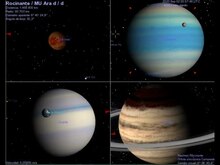
The Mu Arae system consists of an inner Uranus-mass planet in a tight 9-day orbit and three massive planets, probably gas giants, on wide, near-circular orbits, which contrasts with the high-eccentricity orbits typically observed for long-period extrasolar planets. The Uranus-mass planet may be a chthonian planet, the core of a gas giant which has had its outer layers stripped away by stellar radiation.[25] Alternatively it may have formed in the inner regions of the Mu Arae system as a rocky "super-Earth".[24] The inner gas giants "d" and "b" are located close to the 2:1 orbital resonance which causes them to undergo strong interactions. The best-fit solution to the system is actually unstable:[26] simulations suggest the system is destroyed after 78 million years, which is significantly shorter than the estimated age of the star system. More stable solutions, including ones in which the two planets are actually in the resonance (similar to the situation in the Gliese 876 system) can be found which give only a slightly worse fit to the data.[11] Searches for circumstellar discs show no evidence for a debris disc similar to the Kuiper belt around Mu Arae. If Mu Arae does have a Kuiper belt, it is too faint to be detected with current instruments.[27]
The gas giant planet "b" is located in the liquid water habitable zone of Mu Arae. This would prevent an Earth-like planet from forming in the habitable zone, however large moons of the gas giant could potentially support liquid water.[improper synthesis?] On the other hand, it is unclear whether such massive moons could actually form around a gas giant planet, thanks to an apparent scaling law between the mass of the planet and its satellite system.[28] In addition, measurements of the star's ultraviolet flux suggest that any potentially habitable planets or moons may not receive enough ultraviolet to trigger the formation of biomolecules.[29] Planet "d" would receive a similar amount of ultraviolet to the Earth and thus lies in the ultraviolet habitable zone. However, it would be too hot for any moons to support surface liquid water.
| Companion (in order from star) | Mass | Semimajor axis (AU) | Orbital period (days) | Eccentricity | Inclination | Radius |
|---|---|---|---|---|---|---|
| c (Dulcinea) | >10.5551 M🜨 | 0.09094 | 9.6386 ± 0.0015 | 0.172 ± 0.04 | — | — |
| d (Rocinante) | >0.5219 MJ | 0.921 | 310.55 ± 0.83 | 0.0666 ± 0.0122 | — | — |
| b (Quijote) | >1.676 MJ | 1.497 | 643.25 ± 0.90 | 0.128 ± 0.017 | — | — |
| e (Sancho) | >1.814 MJ | 5.235 | 4205.8 ± 758.9 | 0.0985 ± 0.0627 | — | — |
See also[edit]
Notes[edit]

References[edit]
- ^ a b c d e f van Leeuwen, F. (November 2007). "Validation of the new Hipparcos reduction". Astronomy and Astrophysics. 474 (2): 653–664. arXiv:0708.1752. Bibcode:2007A&A...474..653V. doi:10.1051/0004-6361:20078357. S2CID 18759600.
- ^ a b c Gray, R. O.; et al. (July 2006). "Contributions to the Nearby Stars (NStars) Project: Spectroscopy of Stars Earlier than M0 within 40 parsecs: The Northern Sample I". The Astronomical Journal. 132 (1): 161–170. arXiv:astro-ph/0603770. Bibcode:2006AJ....132..161G. doi:10.1086/504637. S2CID 119476992.
- ^ a b Feinstein, A. (1966). "Photoelectric observations of Southern late-type stars". The Information Bulletin for the Southern Hemisphere. 8: 30. Bibcode:1966IBSH....8...30F.
- ^ Wielen, R.; et al. (1999). "Sixth Catalogue of Fundamental Stars (FK6). Part I. Basic fundamental stars with direct solutions". Veröff. Astron. Rechen-Inst. Heidelb. Astronomisches Rechen-Institut Heidelberg. 35 (35): 1. Bibcode:1999VeARI..35....1W.
- ^ Anderson, E.; Francis, Ch. (2012). "XHIP: An extended hipparcos compilation". Astronomy Letters. 38 (5): 331. arXiv:1108.4971. Bibcode:2012AstL...38..331A. doi:10.1134/S1063773712050015. S2CID 119257644.
- ^ a b c d e f g h Soriano, M.; Vauclair, S. (2009). "New seismic analysis of the exoplanet-host star Mu Arae". Astronomy and Astrophysics. 513: A49. arXiv:0903.5475. Bibcode:2010A&A...513A..49S. doi:10.1051/0004-6361/200911862. S2CID 5688996.
- ^ Bruntt, H.; et al. (July 2010). "Accurate fundamental parameters for 23 bright solar-type stars". Monthly Notices of the Royal Astronomical Society. 405 (3): 1907–1923. arXiv:1002.4268. Bibcode:2010MNRAS.405.1907B. doi:10.1111/j.1365-2966.2010.16575.x. S2CID 118495267.
- ^ a b "IAU Catalog of Star Names". Retrieved 28 July 2016.
- ^ Hessman, F. V.; Dhillon, V. S.; Winget, D. E.; Schreiber, M. R.; Horne, K.; Marsh, T. R.; Guenther, E.; Schwope, A.; Heber, U. (2010). "On the naming convention used for multiple star systems and extrasolar planets". arXiv:1012.0707 [astro-ph.SR].
- ^ a b Gozdziewski, K.; Maciejewski, Andrzej J.; Migaszewski, Cezary (2007). "On the extrasolar multi-planet system around HD160691". The Astrophysical Journal. 657 (1): 546–558. arXiv:astro-ph/0608279. Bibcode:2007ApJ...657..546G. doi:10.1086/510554. S2CID 16620036.
- ^ a b c d Pepe, F.; Correia, A. C. M.; Mayor, M.; Tamuz, O.; Benz, W.; Bertaux, J. -L.; Bouchy, F.; Couetdic, J.; Laskar, J.; Lovis, C.; Naef, D.; Queloz, D.; Santos, N. C.; Sivan, J. -P.; Sosnowska, D.; Udry, S. (2006). "The HARPS search for southern extra-solar planets. IX. μ Ara, a system with four planets". Astronomy and Astrophysics. 462 (2): 769–776. arXiv:astro-ph/0608396. Bibcode:2007A&A...462..769P. doi:10.1051/0004-6361:20066194. S2CID 119071803.
- ^ "Planets Around Other Stars". IAU. Archived from the original on 28 September 2006. Retrieved 16 September2006.
- ^ Short, D.; Windmiller, G.; Orosz, J. A. (2008). "New solutions for the planetary dynamics in HD160691 using a Newtonian model and latest data". MNRAS. 386 (1): L43–L46. arXiv:0802.1781. Bibcode:2008MNRAS.386L..43S. doi:10.1111/j.1745-3933.2008.00457.x. S2CID 15410895.
- ^ "Notes for star HD 160691". Title Extrasolar Planets Encyclopaedia. Archived from the original on 22 December 2008. Retrieved 11 April 2009.
- ^ NameExoWorlds: An IAU Worldwide Contest to Name Exoplanets and their Host Stars. IAU.org. 9 July 2014
- ^ NameExoWorlds The Process
- ^ Final Results of NameExoWorlds Public Vote Released, International Astronomical Union, 15 December 2015.
- ^ The Proposals page for Mu Arae, International Astronomical Union, 3 January 2016.
- ^ NameExoWorlds The Approved Names
- ^ "IAU Working Group on Star Names (WGSN)". Retrieved 22 May 2016.
- ^ "Bulletin of the IAU Working Group on Star Names, No. 1"(PDF). Retrieved 28 July 2016.
- ^ Butler; Tinney, C. G.; Marcy, Geoffrey W.; Jones, Hugh R. A.; Penny, Alan J.; Apps, Kevin (2001). "Two New Planets from the Anglo-Australian Planet Search". The Astrophysical Journal. 555(1): 410–417. Bibcode:2001ApJ...555..410B. doi:10.1086/321467. hdl:2299/137.
- ^ McCarthy, Chris; et al. (2004). "Multiple Companions to HD 154857 and HD 160691". The Astrophysical Journal. 617 (1): 575–579. arXiv:astro-ph/0409335. Bibcode:2004ApJ...617..575M. doi:10.1086/425214. S2CID 119446133.
- ^ a b Santos, N. C.; Bouchy, F.; Mayor, M.; Pepe, F.; Queloz, D.; Udry, S.; Lovis, C.; Bazot, M.; et al. (2004). "The HARPS survey for southern extra-solar planets II. A 14 Earth-masses exoplanet around μ Arae". Astronomy and Astrophysics. 426 (1): L19–L23. arXiv:astro-ph/0408471. Bibcode:2004A&A...426L..19S. doi:10.1051/0004-6361:200400076. S2CID 14938593.
- ^ Baraffe, I.; Alibert, Y.; Chabrier, G.; Benz, W. (2006). "Birth and fate of hot-Neptune planets". Astronomy and Astrophysics. 450(3): 1221–1229. arXiv:astro-ph/0512091. Bibcode:2006A&A...450.1221B. doi:10.1051/0004-6361:20054040. S2CID 15574680.
- ^ Agnew, Matthew T; Maddison, Sarah T; Horner, Jonathan; Kane, Stephen R (June 2019). "Predicting multiple planet stability and habitable zone companions in the TESS era". Monthly Notices of the Royal Astronomical Society. 485 (4): 4703–4725. doi:10.1093/mnras/stz345. Retrieved 28 April2020.
- ^ Schütz, O.; Bönhardt, H.; Pantin, E.; Sterzik, M.; Els, S.; Hahn, J.; Henning, Th. (2004). "A search for circumstellar dust disks with ADONIS". Astronomy and Astrophysics. 424 (2): 613–618. arXiv:astro-ph/0408530. Bibcode:2004A&A...424..613S. doi:10.1051/0004-6361:20034215. S2CID 25921357.
- ^ Canup, R.; Ward, W. (2006). "A common mass scaling for satellite systems of gaseous planets". Nature. 441 (7095): 834–839. Bibcode:2006Natur.441..834C. doi:10.1038/nature04860. PMID 16778883. S2CID 4327454.
- ^ Buccino, A.; Lemarchand, Guillermo A.; Mauas, Pablo J.D. (2006). "Ultraviolet Radiation Constraints around the Circumstellar Habitable Zones". Icarus. 183 (2): 491–503. arXiv:astro-ph/0512291. Bibcode:2006Icar..183..491B. doi:10.1016/j.icarus.2006.03.007. S2CID 2241081.
External links[edit]
 | Wikimedia Commons has media related to Mu Arae. |
- GJ 691
- HR 6585
- Britt, Robert Roy (25 August 2004). "'Super Earth' Discovered at Nearby Star". Space.com. Retrieved 17 July 2008.
- "Fourteen Times the Earth". European Southern Observatory. 25 August 2004. Archived from the original on 7 June 2007. Retrieved 17 July 2008.
- "Mu Ara: a system with 4 planets". Geneva Observatory. Archived from the original on 9 June 2008. Retrieved 17 July 2008.
- "Mu Arae". SolStation. Retrieved 17 July 2008.
- Image Mu Arae
- Extrasolar Planet Interactions by Rory Barnes & Richard Greenberg, Lunar and Planetary Lab, University of Arizona


댓글
댓글 쓰기